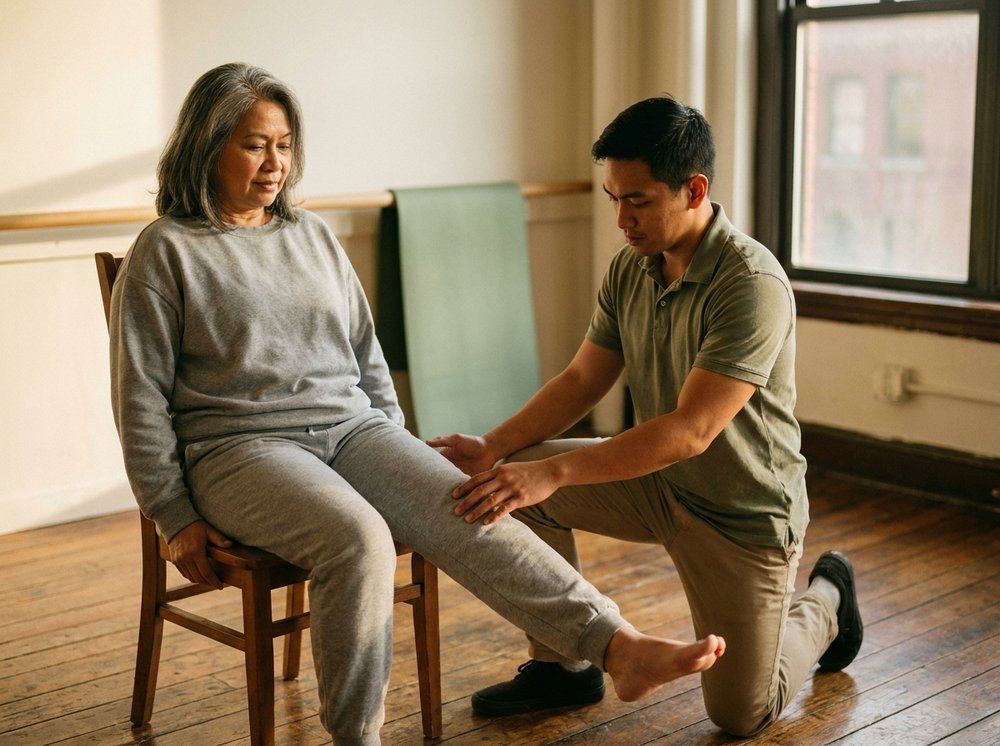
Stiff knees do not need a gym. They need five minutes, a quiet spot on the banig or the edge of the bed, and a routine done often enough to become boring. That boredom — the sheer unremarkable habit of it — is what carries a 62-year-old tita back up her own apartment stairs without pausing on the landing.
I have been a physiotherapist for fourteen years, most of them spent listening to Filipino knees. Almost every patient who comes to our mobility and joint rehab room arrives thinking they need something heroic — a machine, a supplement, a new doctor. In truth they almost always need the same quiet, daily ten minutes. Here is the routine I hand out most often, written exactly the way I explain it in session.
Before you begin: the ninety-second check
Sit on the edge of your bed with both feet flat. Don’t start any exercise yet. Ask three questions:
- Where is the stiffness? Front of the knee, behind the knee, inside along the shinbone, or diffuse?
- Is there sharp pain, or just heaviness? Sharp pain changes the plan — heaviness is normal morning stiffness.
- Can you fully straighten the knee, slowly, without wincing? If yes, proceed. If no, begin only with the first exercise.
This short check is the most skipped, most important part of the ritual. If anything feels sharp, catching, or locking, stop and book an assessment — I explain honestly when to come to a PT versus a manghihilot in our note on how to choose between hilot and physiotherapy.
The five-minute morning routine
Do the exercises in this exact order. Breathe out on the effort. If you can talk in a normal voice throughout, the intensity is right.
1. Quad sets — 10 repetitions, 5-second hold
Sit on the bed with both legs straight in front of you. Place a rolled towel or small pillow under the back of the painful knee. Press the back of your knee down into the towel by tightening the thigh muscle — you should see the kneecap slide upward slightly. Hold 5 seconds, release. Repeat 10 times.
This wakes up the quadriceps without moving the joint. It is the gentlest possible starting point and the one I give to knees fresh out of a flare.
2. Heel slides — 10 each side
Still on the bed, straight-legged. Slowly slide your heel toward your bottom, bending the knee as far as is comfortable. Hold for 2 seconds at the deepest point. Slide it back out. Ten slow repetitions on each side, even if only one knee hurts — the joints like symmetry.
Think of this like a door hinge being oiled, not forced. Never bounce at the end range.
3. Ankle pumps and circles — 20 pumps, 10 circles each direction
Feet straight out. Point the toes down, pull them back toward your shins. Twenty times. Then ten slow circles in each direction. This sounds trivial, but the ankle and knee are married — a stiff ankle quietly overloads the knee every step of your day.
4. Seated marches — 20 slow counts
Move to the edge of the bed or a sturdy chair, both feet flat. Slowly lift one knee, pause, lower. Alternate. Twenty counts total, about the slowness of a clock’s tick. You are training the muscles that let you climb into a jeepney without grabbing the handrail in panic.
5. Mini squats to a chair — 8 repetitions
Stand behind a sturdy chair or in front of the dining chair. Holding the back for balance, bend your knees just 20 to 30 degrees — the depth of reaching down for a falling slipper. Straighten. Do eight slow ones. If this is uncomfortable, stay only with steps 1 to 4 for the first two weeks.
Joints do not heal because you push harder. They heal because you show up, gently, on Tuesday when you did not feel like it.
After the routine: the thirty-second warm-down
Stand up slowly. Walk the length of your room four times. Notice what has changed — in most of my clients, the knee feels about 30 to 40 percent looser than before the routine. That is your baseline. As the weeks pass, the morning stiffness itself begins to shrink from twenty minutes to five, and then to almost nothing.
When to add more, and when not to
After three to four weeks of doing the routine daily, you can:
- Add a second round in the afternoon.
- Increase mini squats to 12, then 15 repetitions.
- Introduce a short 10-minute walk in the cooler morning air.
Do not add weights, resistance bands, or stair work on your own. That is where patients often slip — they feel good and leap ahead, and the knee punishes them for it the next morning. If you want to progress past the basics safely, come see us for an assessment, or at minimum pair the routine with a hilot session every three to four weeks to keep the surrounding muscles soft.
Knees also need posture support from above. The hips, lower back, and even the shoulders shape how a knee loads with every step — I wrote a companion note on this in posture habits that protect aging joints. Think of it as the second half of this routine, on a longer timescale.
Stiff knees are rarely a one-morning problem. They are a slow story. A five-minute ritual, done most days for a year, rewrites it quietly. And if you need help from another direction — warm hands, tradition, or the deep reset of our notes on combining hilot with modern rehab — the sanctuary is a short jeepney ride away.