My apprentice asked me once, “Tita, kung aching knee, hilot o physio?” I told her: the honest answer is that it depends on what the knee is actually saying. Both trades have their gifts. Neither one is complete on its own. The real skill — for us, for the patient, for the physiotherapist down the hall — is knowing which door to knock on first, and when to open the second one.
I have been a manghihilot for thirty-two years. I trained under my grandmother in Bohol before the word “evidence-based” meant anything. Then I worked for fifteen years alongside PTs at a Quezon City rehab clinic, and I learned that the smart ones and the traditional ones are saying, most of the time, the same thing in different languages. The sanctuary we built at Lunas Hilom is where those two languages meet on purpose.
What each one actually does
Let me describe both plainly, without marketing.
Hilot, in honest terms
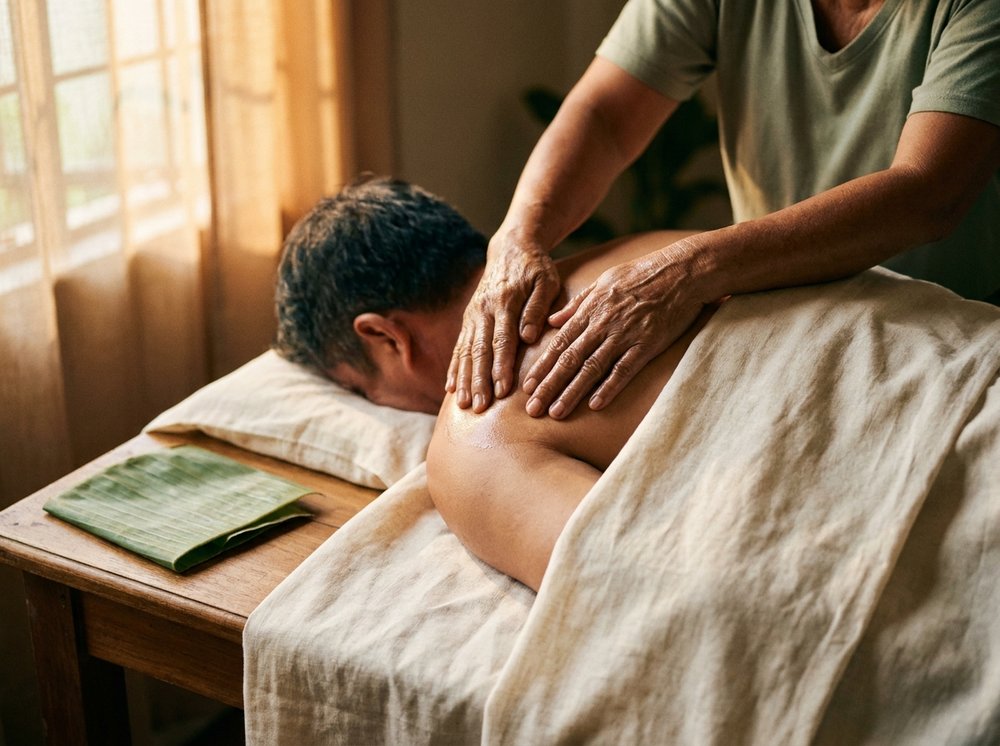
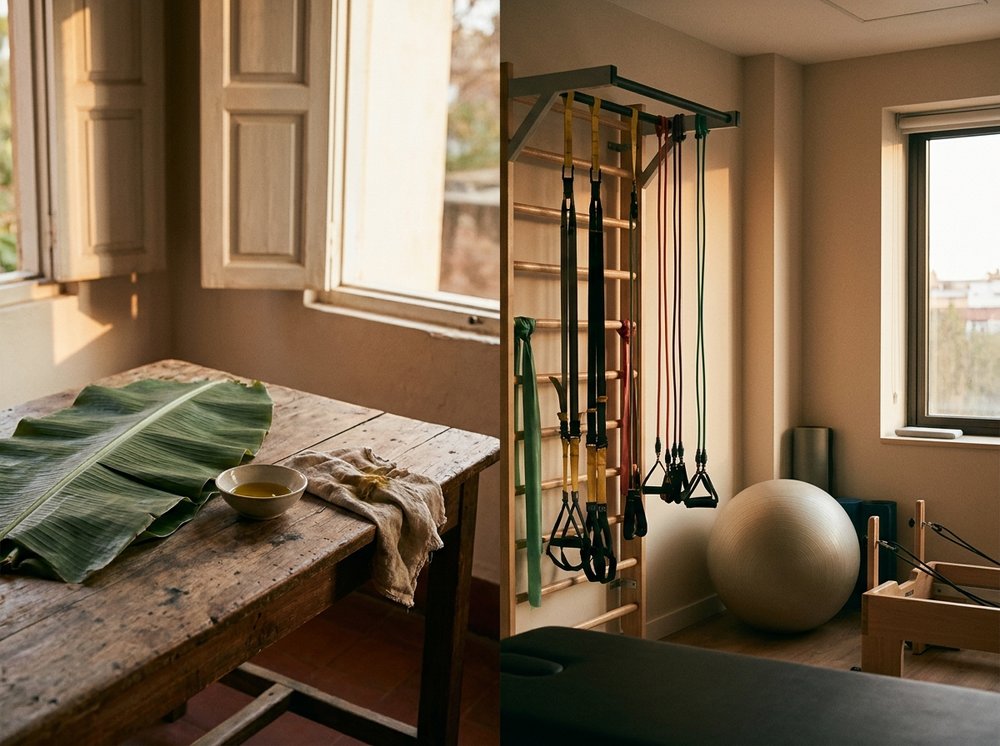
A manghihilot reads the body by touch. We feel for the lamig — the subtle cold pockets where circulation has slowed, the tight bands of fascia that have been holding too long, the pulse asymmetry that tells us something on the right side is guarding the left. We work with warm hands, coconut oil, sometimes banana leaf compresses, and long rhythmic strokes that lengthen muscles and resettle soft tissue.
What hilot is genuinely excellent at: deep muscular and fascial release, whole-body recalibration, chronic tension that has not yielded to stretching, the kind of stored stress that sits behind a shoulder blade for years, and post-stress recovery.
What hilot cannot do: set a broken bone, rehabilitate a surgical knee, diagnose a herniated disc, or prescribe a progressive strengthening program. A good manghihilot does not pretend otherwise.
Physiotherapy, in honest terms
A physiotherapist tests the body with measurement. They check ranges of motion in degrees, strength against resistance, balance under load. They build a progressive plan — this week 10 repetitions, next week 12 — and adjust it weekly based on how you are recovering. They know how to handle a post-surgical joint, a sports injury, a stroke rehabilitation, a chronic instability.
What PT is genuinely excellent at: structured rehabilitation, progressive strengthening, movement retraining, objective measurement of progress, and anything post-surgical or post-injury.
What PT on its own often misses: the layered, years-old soft-tissue holding patterns that did not come from one injury, the whole-body rhythm of a tired Filipino body that has raised three children and stood at a cooking stove for forty years.
A side-by-side — when to book which
Here is the clearest way I can put it. Match your situation to the list.
Book physiotherapy first when:
- You have had recent surgery on a joint — knee replacement, ACL, rotator cuff. You need a supervised rehab plan.
- You have a new injury from a specific event — a fall from a jeepney, a twisted ankle, a sudden back catch while lifting.
- You have lost measurable range of motion or strength and need a structured progression to get it back.
- There is suspected nerve involvement — numbness, tingling, shooting pain down a limb.
- You have been prescribed rehab by a doctor. Follow the prescription first.
Our mobility and joint rehab room exists for exactly these situations — a PT-led assessment, measurement, and plan, with hands-on work woven in.
Book hilot first when:
- You have long-standing, diffuse muscular tension that comes from stress, posture, and years of accumulation rather than a single injury.
- You have chronic shoulder or lower back tightness that stretches and exercises have not fully resolved.
- Your body feels imbalanced — one side tighter than the other — without any clear medical cause.
- You are recovering from a period of heavy emotional or caregiving stress, and the tension has settled into your neck, shoulders, and upper back.
- You are using hilot preventively — every three to four weeks — to keep aging joints mobile.
Do both, in sequence, when:
- You have chronic joint pain that is six months old or more and involves both stiff soft tissue and underlying weakness.
- You finished a course of physiotherapy and the motion is back but something still feels held — hilot then smooths out the leftover holding.
- You want the most complete recovery possible. Hilot first softens, PT then rebuilds strength in the newly released range.
Western medicine measures what it can see. Filipino healing listens to what the body has been holding. Both are true. Neither is enough alone.
How we work together at the sanctuary
At Lunas Hilom, we have one PT — Aleksi — and six manghihilots. We refer to each other constantly. A patient walks in with a knee complaint, and we decide together whether the first session should be hands-on softening, measured assessment, or both in sequence. After the first visit, we usually know which rhythm the body wants.
A common arc for a chronic joint patient looks like this:
- Session 1 — PT assessment. Measurement, range of motion, strength, a conversation about history. A short home routine is handed out.
- Session 2 — hilot. Ninety minutes of deep soft-tissue work to soften what the assessment revealed.
- Sessions 3–5 — PT-led rehab. Weekly, progressive, with hands-on work woven in.
- Session 6 — hilot, longer form. Consolidation, release of whatever held on.
- Maintenance — every 3–4 weeks, alternating. The home routine continues daily.
This is not a rigid protocol. It is the shape we most often land on, in a sanctuary where the two traditions are in daily conversation.
The pitfalls we watch for
Honest notes:
- Do not go to a manghihilot expecting measurement in degrees. That is not what the tradition does.
- Do not expect a physiotherapist to read subtle fascial holding patterns the way a hilot trained for thirty years does. That is also not what the training does.
- Do not accept any practitioner — traditional or modern — who tells you the other side of the fence is useless. That is a sign of insecurity, not skill.
- If you are taking medications or have a chronic condition, tell both your PT and your manghihilot. We need to know.
For a wider view of how traditional Filipino joint care was shaped by generations of practice — and how the best manghihilots of my teachers’ generation already thought in these layered terms — our note on the roots of Filipino hilot is the piece I return to often.
And if you are just beginning the daily work at home, the simplest doorway is still the morning routine our PT wrote in daily mobility rituals for stiff knees. Start there. The hands-on care, hilot or PT or both, will be waiting whenever you need the deeper work.
There is no competition here. Only two quiet trades, working the same tired body from two directions, until it remembers what ease felt like.