When Tita Remy first asked me to join her sanctuary in 2019, I hesitated for a long time. I had a decent clinical practice in Tomas Morato, I liked the rigour of a PT clinic, and I had, honestly, some of the usual professional snobberies about traditional bodywork. I thought hilot was kind, well-meant, and empirically wobbly. I thought I might learn a little and teach a lot.
Six years later, I am a different physiotherapist. This piece is about what changed, why, and what the combination of hilot and modern mobility care actually looks like on the treatment table — because a lot of guests ask us this, and the answer deserves more than a brochure paragraph.
What each practice does best
Physiotherapy, at its best, is very good at three things. First, differential assessment — figuring out whether a knee pain is coming from the meniscus, the patellofemoral joint, the hip that is compensating, or a weak glute medius. Second, graded loading — progressively training tissue (muscle, tendon, cartilage) to tolerate what it needs to tolerate. Third, evidence-based protocols for specific conditions, from frozen shoulder to sciatica.
Hilot, at its best, is very good at three different things. First, whole-body reading — a manghihilot's pulse work and palpation give her a map of the body's tensions that is different from the PT's orthopaedic tests, and often catches things the tests miss (a held-breath pattern in the diaphragm, a jaw tension that is pulling the neck). Second, slow, unhurried tissue work that calms the nervous system in a way that exercise-based rehab rarely has time for. Third, continuity of care — the same manghihilot seeing the same guest over years, building a living record of that person's body.
Neither practice, alone, covers what a tired, ageing, pain-weary body needs. A good PT clinic can hand a 62-year-old woman with knee osteoarthritis a strong strengthening programme, but she may be too sore and too anxious to do it. A good hilot sanctuary can relieve her pain in the short term but may not progress her tissue capacity. Together — and this is what we have learned the hard way — the two practices meet her where she is and walk her forward.
What I did not expect to learn from Tita Remy
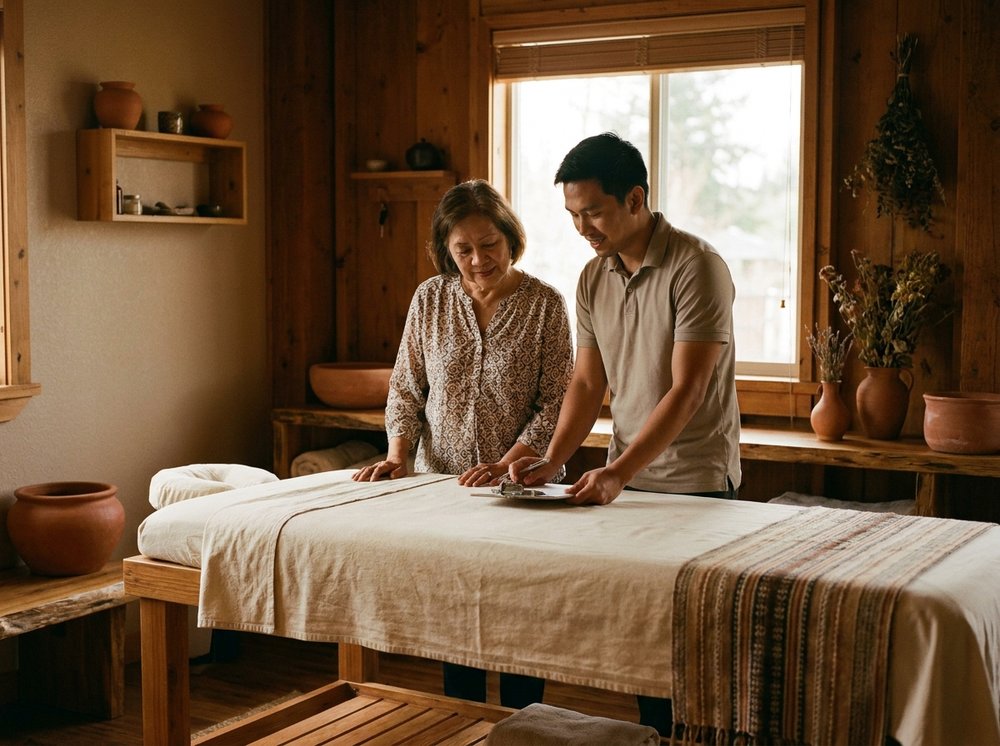
The first thing I learned was patience. Filipino clinical culture is not unhurried; we are often seeing a patient every twenty minutes. Tita Remy takes an hour. She talks, she reads the pulse, she warms the oil, she works slowly, she stops before she has to. The first few months, I found this infuriating. After six months, I noticed my own assessment quality improving when I gave myself more time. Something about working beside her recalibrated what a "session" should feel like.
The second thing I learned was palpation depth. PT training teaches palpation, but it does not teach what a manghihilot of thirty years learns — the subtle differences between muscle tone that is merely tight, tone that is guarding a deeper restriction, and tone that is masking something neurological. I still cannot do what Tita Remy does, but I have grown enormously. And the reverse has happened too: Tita Remy has learned clinical red flags she did not have before, so she refers out more confidently when a case is outside the sanctuary's scope.
"You have the map of the books. I have the map of the bodies. We need both. A body is never exactly what the book says."
— Tita Remy Salazar, in conversation with the author, 2020
The protocols we built
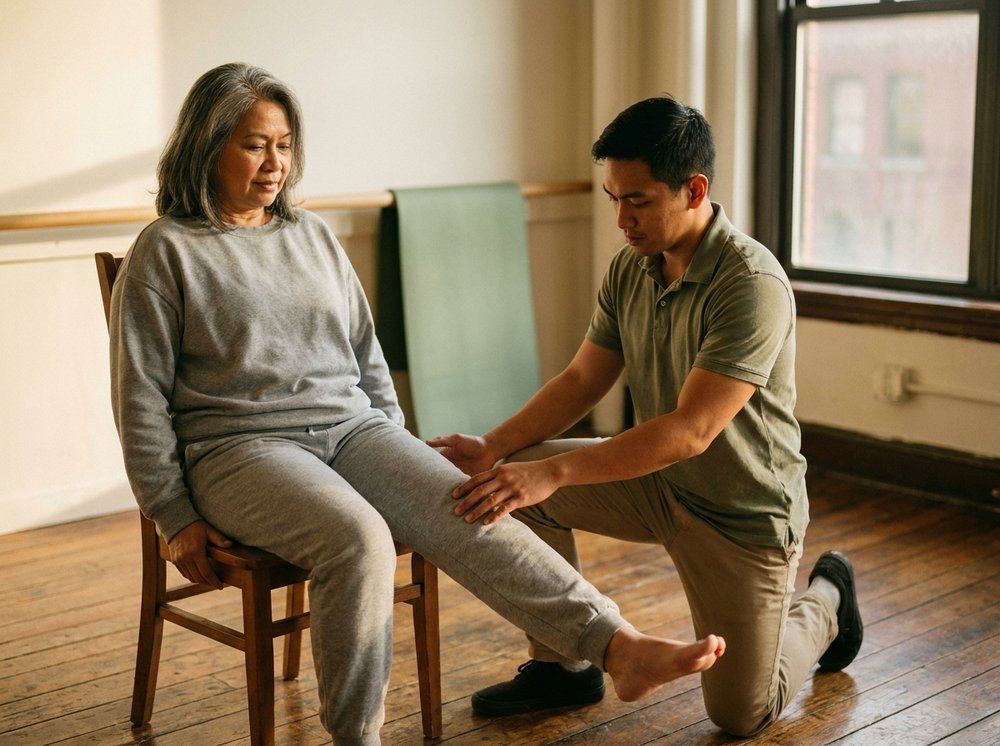
We have three combined protocols now, each developed over about two years of trial and refinement. They all live inside our Mobility & Joint Rehab service — the 90-minute session co-led by a PT and a manghihilot.
Protocol 1: The Knee Renewal Series. For guests with early to moderate osteoarthritis. Session opens with 20 minutes of hilot on the thigh, calf, and glute, slow and warming. Middle 40 minutes is PT-led: clinical assessment, graded strengthening (wall squats, step-ups appropriate to capacity), range-of-motion work. Final 30 minutes is cupping on the quadriceps and calf, plus closing hilot on the knee itself and education for home work. We usually run this as a 4-session series over 4–6 weeks.
Protocol 2: The Shoulder Unwind. For guests with frozen shoulder or chronic rotator-cuff tension. Session opens with ventosa cupping on the upper back (20 min) to decompress the deep fascia. Middle 40 minutes is clinical PT: controlled range-of-motion, scapular stabilisation, graded load. Final 30 minutes is hilot along the arm, neck, and jaw — because, as Tita Remy taught me, a shoulder does not live on its own. The guest goes home with a simple home routine, on paper, with drawings.
Protocol 3: The Low-Back Resettle. For chronic non-specific low-back pain. We open with 25 minutes of hilot along the paraspinals, glutes, and hamstrings. PT-led core work takes the middle 30 minutes, using the floor and nothing more elaborate. Final 35 minutes is a combination of cupping along the QL and a slow closing hilot. We discourage passive-only approaches for the back; the PT element is non-negotiable, because the back responds to graded load. But the hilot frames and follows the load in a way that makes the guest willing to return.
Why the combination outperforms either alone
Three reasons, in my clinical experience.
First, adherence. Guests who love coming back keep coming back. A purely PT approach, for older Filipinos especially, can feel clinical and cold; they stop at session two. A purely hilot approach feels warm but does not progress their capacity; they feel temporarily better but not structurally changed. The combination makes them structurally better while feeling cared for. They finish the series.
Second, pain modulation. The nervous system is central to chronic pain. Hilot, with its slow, warm, unhurried touch, directly down-regulates the fight-or-flight response. Once the nervous system is calmer, the tissue is more willing to accept the graded load that PT prescribes. This is not mystical; it is basic pain science.
Third, early detection. A manghihilot who sees a guest monthly notices changes — a new limp, a new held pattern, an old injury flaring — sometimes before the guest herself does. This is an early-warning system that no quarterly PT check-up replicates. When Tita Remy tells me, "Aleks, the hip on Mrs Cruz is not right today," I pay attention. She is almost always right.
Where we refer out
I want to be clear about limits. Hilot + mobility work is not the answer to everything. We refer out — to orthopaedic surgeons, to rheumatologists, to sports medicine doctors — for suspected fractures, suspected inflammatory arthritis, significant neurological signs, or any condition where the evidence points clearly to a medical intervention we cannot offer. A thoughtful sanctuary knows when to say: this is beyond us, let us help you find the right person.
This sanctuary exists inside a longer tradition. The old hilot practice is centuries old, and its science-adjacent cousins like ventosa cupping are older still. What we add, with modern PT, is one more layer — a structured understanding of loading, strengthening, and tissue adaptation — that belongs alongside the old knowing, not above it.
If you are considering a combined session for a stubborn joint problem, or want to understand what your first visit might look like, our overview of what to expect from your first session is a good place to start. We are glad you are reading this. We will be gladder still to meet you, if you come in.