My grandfather in Sagada had two pairs of hands. The first was for the rice terraces — broad, dark, cracked along the thumbs from decades of pulling weeds out of mud. The second came out at night, when a neighbour arrived at the door with swollen feet after a long walk from Bontoc. Those hands were gentler. They reached for a bundle of bamboo sticks tied with abaca twine, and they began a rhythm I have been listening to for fifty years.
This is the ritual we call dagdagay. It is a foot therapy specific to the Cordillera — practised in Mountain Province, Benguet, and parts of Ifugao — and it is older than anyone in my village can tell me. When people ask me how old dagdagay is, I say: older than the bamboo my grandfather used, and his bamboo was older than I am.
What dagdagay is, in plain description
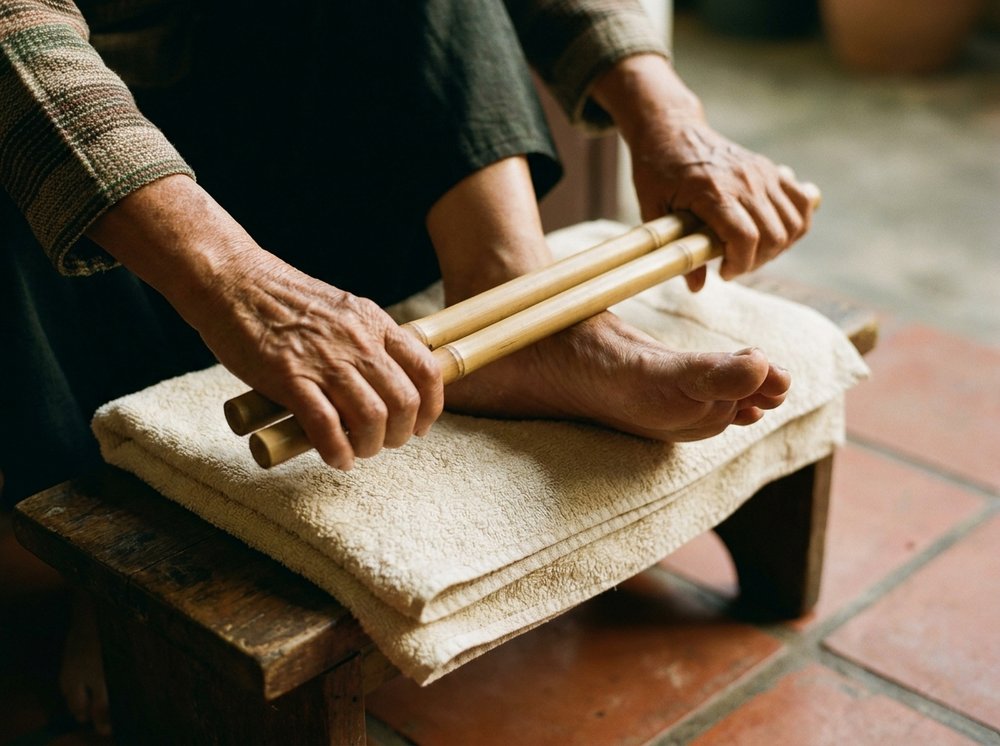
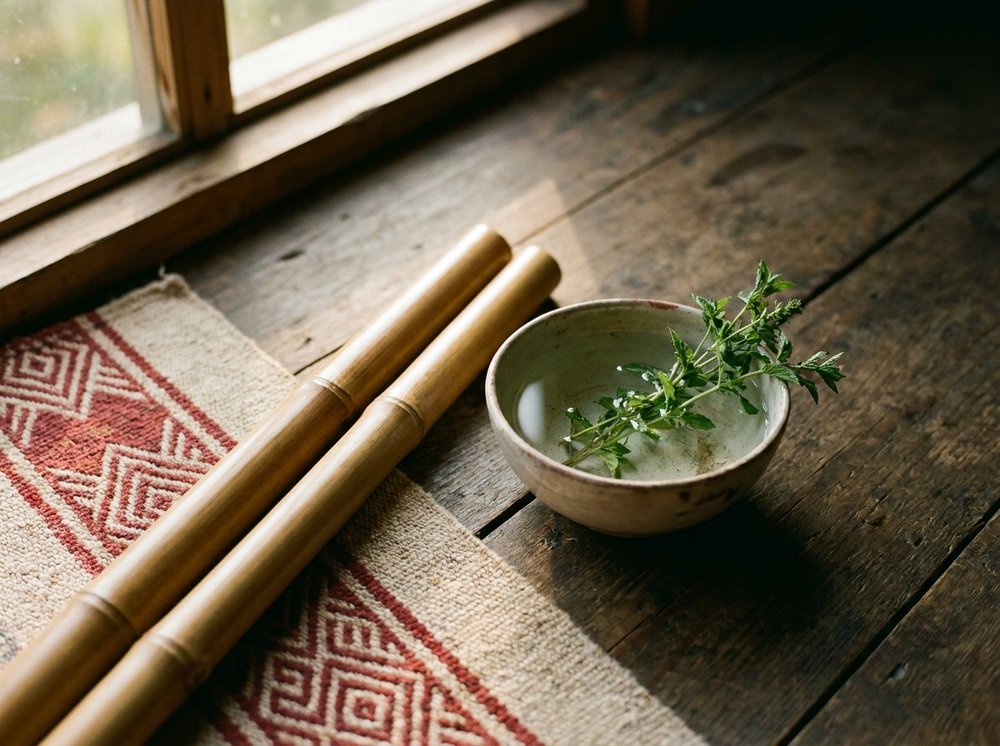
The practitioner uses two smooth bamboo sticks, usually about 18 inches long and the width of two fingers, cut from a specific kind of kawayan tinik aged over a fire for months until the outer skin hardens to a warm honey colour. The client sits or lies down, feet bare. The bamboo is moved along the sole of the foot in alternating strokes — left stick, right stick, left stick, right stick — in a rhythm that is almost like music. It is not a pounding. It is a rolling pressure, sometimes sliding along the arch, sometimes tapping the heel, sometimes pressing slowly into the soft tissue between the metatarsals.
Twenty minutes in, most guests begin to feel the way the gulong (circling) in their ankles eases. Thirty minutes in, many of them fall asleep. This is, I think, the oldest insomnia remedy in the Cordillera, though nobody ever called it that.
How the ritual almost died
After the war — the Second World War, which in our mountains was a very long and cruel time — many of the old manghihilot of the Cordillera were dead, scattered, or too exhausted to keep teaching. The generation that came up in the 1950s and '60s had other hungers: school, Manila, lowland jobs, the new lowland idea of what it meant to be modern. My mother's generation was told that dagdagay was something only very poor mountain people did because they could not afford proper medicine.
By the time I was born in the late 1960s, there were only a handful of dagdagay practitioners left in Sagada and Bauko, most of them men in their seventies. My grandfather was one of them. He said to me, when I was maybe eleven, "If you do not learn this, it will die. And if it dies, we will forget what our feet are for."
"The feet carry the whole mountain. When you walk all day in the rice terraces, your soul goes down into your soles. At night, we must bring it back up."
— Apo Manuel Daplas, Sagada, c. 1981
I did not understand him then. I understand him now.
Learning the rhythm
I began with my own feet. He worked on me for ten minutes every evening for two years before he let me touch his. Then he sat in his rattan chair and closed his eyes and said, "Do what I did." I was terrible. The rhythm was wrong. The pressure was too shy in the arch and too hard at the heel. But he corrected me with small noises — a click of the tongue for too hard, a hum for better, silence for right. Silence, in my grandfather's house, was the highest praise.
I worked with him for maybe six years before I left Sagada for nursing school in Baguio. I thought I was leaving the ritual behind. In fact I carried it with me in my hands.
Why it works — a practitioner's view
I am not a physiologist. I am a woman who has rolled bamboo along feet for five decades. What I can tell you from observation is this: the foot has twenty-six bones, more than thirty joints, and more small muscles than most people can name. A day of standing or walking compresses all of that. The rhythm of dagdagay is designed to gently re-mobilise each of those little joints, while the bamboo itself — warm, slightly textured, alive in a way metal never is — seems to soothe the skin and the nervous system at the same time.
For guests in their sixties and seventies with neuropathy, plantar fasciitis, or the accumulated stiffness of decades on cement floors, dagdagay is often the gentlest thing we can offer. If the foot pain is linked to a larger pattern — tight calves, tight low back, old knee trouble — we combine the dagdagay session with hilot along the legs and sometimes with work on the hip and ankle together. Feet are rarely the whole story.
Bringing it to Quezon City
I came to work with Tita Remy in 2012. She had heard about me from a client who visited Sagada and went home with feet that felt twenty years younger. She asked, gently, if I would teach. I was nervous. Sagada rituals carried to Manila had sometimes been flattened into something decorative — bamboo on a menu between a sauna and a facial. Tita Remy promised me that dagdagay would be offered with its whole rhythm intact, or not at all.
Today two of us are dagdagay specialists at Lunas Hilom. We have taught the others enough to recognise who needs it. We still cut our own bamboo when we can — a friend from Bauko sends us a bundle twice a year — and we still sharpen our rhythm on each other's feet in the quiet afternoons when there are no guests.
The Cordillera tradition is part of a much larger Philippine healing heritage — four hundred years of hilot and more — and it is also distinct from it. Dagdagay is mountain work. It asks for mountain patience. But the feet it works on are the same feet that carry everyone, everywhere, every day. If you have never tried it, come on a weekday afternoon. You will hear the rhythm. You will understand my grandfather better than I can explain him.
And if, afterwards, you are curious about how the rest of our sanctuary weaves the old traditions with modern clinical care, you might read our piece on hilot with modern mobility work.