I am the newest of the manghihilots in this house. I came to ventosa through injury — a stubborn rhomboid knot that no massage could soften after a year of bad posture and too many long drives. Tita Remy cupped my upper back one Tuesday afternoon and I walked out feeling as if someone had taken a handful of rubber bands off my shoulder blades. I came back the next week to ask how it worked. I have been asking ever since.
What I want to do in this piece is not defend cupping and not apologise for it. I want to tell you, as honestly as I can, what the modern journals say about it, what they don't, and how that maps to what the older hands in our sanctuary have always said about our ventosa work.
What ventosa actually is
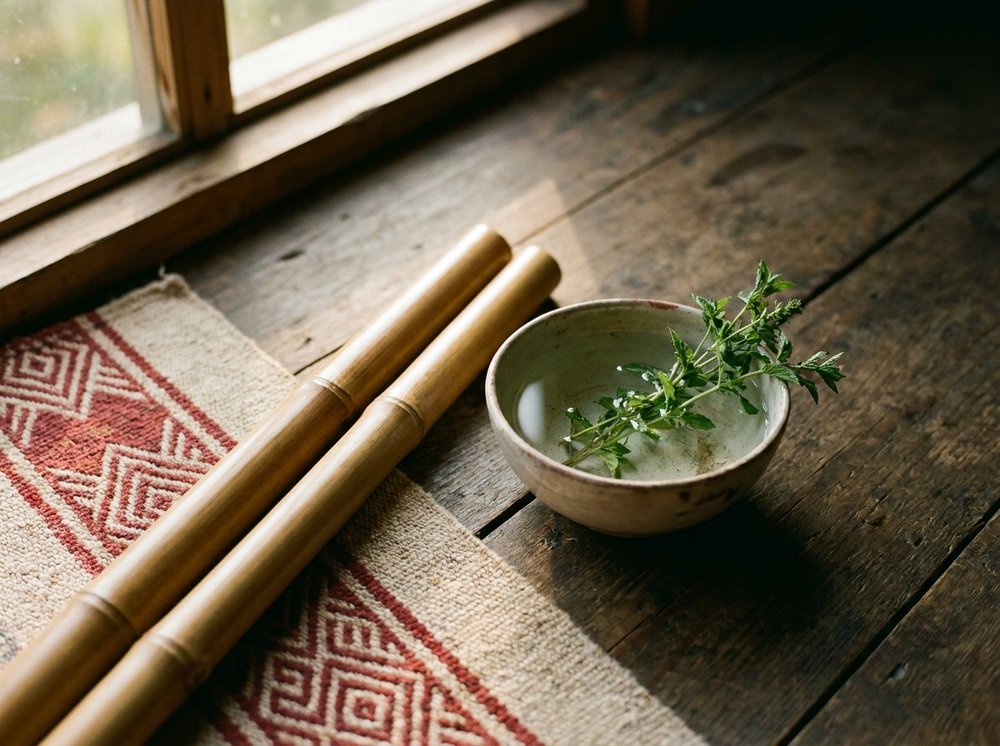
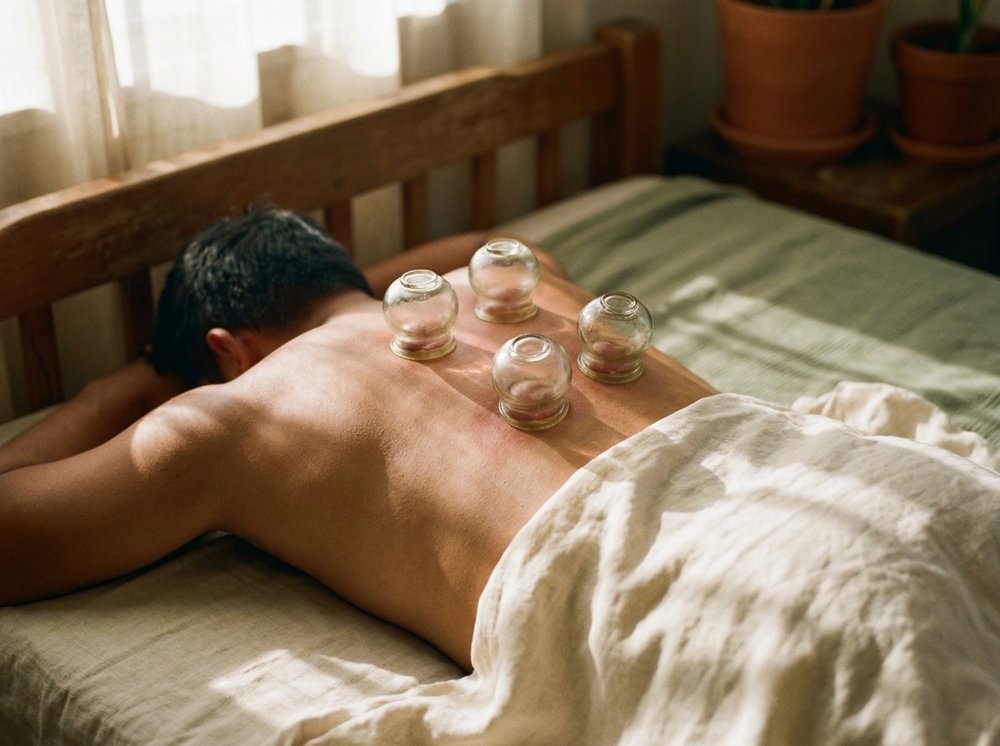
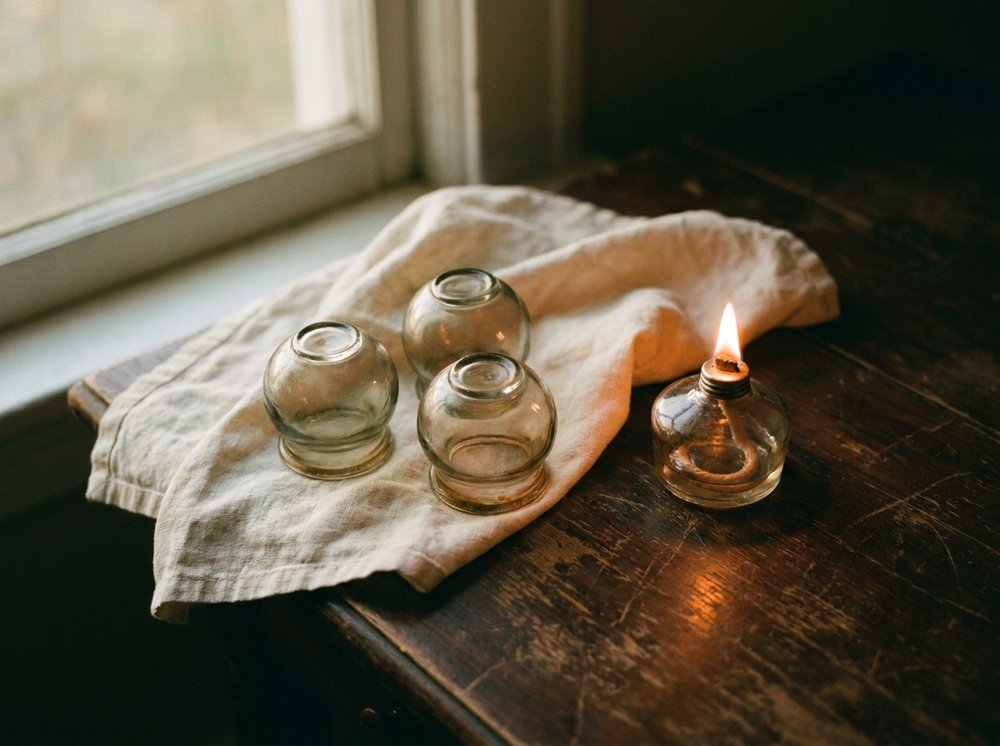
Ventosa is the Filipino-Spanish name for a practice that exists, in different clothes, across the world — Chinese ba guan, Arabic hijama, Greek sikya. A cup (glass, silicone, or in the oldest Philippine versions, bamboo) is placed on the skin, and a small vacuum is created inside it — traditionally by burning a wick for a second, modern practice sometimes uses a hand pump. The skin and superficial fascia rise into the cup. The cup sits for three to ten minutes, or is slid along oiled skin.
The effect, in plain language: the cup does to the tissue the opposite of what a massage thumb does. A thumb compresses. A cup decompresses. The fascia is gently pulled away from the muscle beneath it, and blood is drawn into the capillaries of the area, which is what produces the famous circular marks — not bruises, but petechiae from local blood stasis breaking up.
What the journals have looked at
Over the last fifteen years, cupping has received more serious attention than it did in the previous century. A 2018 review in Complementary Therapies in Medicine pooled data from eleven controlled trials on cupping for chronic neck and shoulder pain and found a statistically meaningful short-term reduction in pain scores compared with usual care. A 2020 paper in the Journal of Traditional Chinese Medicine looked at myofascial trigger points in the upper trapezius and reported improvements in pressure-pain threshold after four sessions. A smaller 2019 trial in Journal of Bodywork and Movement Therapies found changes in local tissue elasticity measurable by ultrasound elastography.
None of this makes ventosa a cure for anything. What it does is suggest, with reasonable evidence, that cupping produces a measurable mechanical and circulatory effect in the tissue it is applied to, and that this effect is associated — at least in the short term — with reductions in pain in conditions like chronic trapezius tightness, shoulder impingement, and some kinds of mid-back discomfort.
What the journals do not prove
Let me be clear about the limits. The studies are mostly small. Blinding is very difficult — it is hard to pretend you are not being cupped. Some of the positive results fade within a few weeks if no other change is made. And the idea that cupping removes "toxins" from the body has no serious evidence behind it; what it moves is local fluid and fascia, not mysterious substances.
For knee osteoarthritis specifically — a common reason our older guests come to us — the evidence for cupping as a primary treatment is much thinner. It can play a supporting role in reducing muscular guarding around the knee, which is why we often combine it with targeted mobility work for the knee, but no serious practitioner should sell cupping as a fix for cartilage loss.
What Filipino practitioners have known
Here is what interests me: most of what the journals are now confirming, the older manghihilots in this country have been saying for generations, in different vocabulary. My own grandmother in Bicol used to say that ventosa "pulls the cold out of the muscle." In clinical language, she meant that it increases local circulation to an area where blood flow has become sluggish from chronic tension. She did not read studies. She read backs.
"We cannot treat what we cannot feel. The cup is an extra finger — it reaches under the skin where our thumb cannot go."
— Nanay Paz, manghihilot, Tagbilaran, 1978 (quoted in PITAHC oral-history archive)
This pairing of tradition and modern language is part of why our sanctuary exists. Hilot has been practised in these islands for more than four centuries, and it has always been empirical — if a method did not help people, the community stopped using it within a generation. What modern research does is put numbers to what the hands already knew.
How we use ventosa at Lunas Hilom
Our ventosa sessions are 75 minutes. The cupping itself occupies about 20–25 minutes of that time; the rest is preparing the tissue with warm oil and hilot, and then gently moving the cupped area through range of motion afterwards. We use glass cups with fire (the traditional method) for most clients, and silicone cups for guests who are anxious about flame or whose skin is fragile.
We do not cup over active infection, broken skin, deep varicose veins, or areas of recent surgery. For guests on blood thinners, we use lighter suction and shorter dwell times. If a guest has fragile skin (common after sixty, especially if there has been long-term steroid use), we go softer still, or choose sliding cups with plenty of oil rather than static cups.
What it feels like, and what to expect after
The sensation is a slow, firm tug — not sharp, not painful. Most guests describe it as "someone pulling a weight off." The circular marks that appear are darker where the tissue was more stagnant and lighter where it was already moving well; they fade in four to seven days. You may feel slightly sleepy or thirsty afterwards. Drink water, eat something warm, and rest if you can.
The tradition is older than the evidence. The evidence is catching up. What matters, in the end, is that the work is done carefully, by hands that know when to stop.