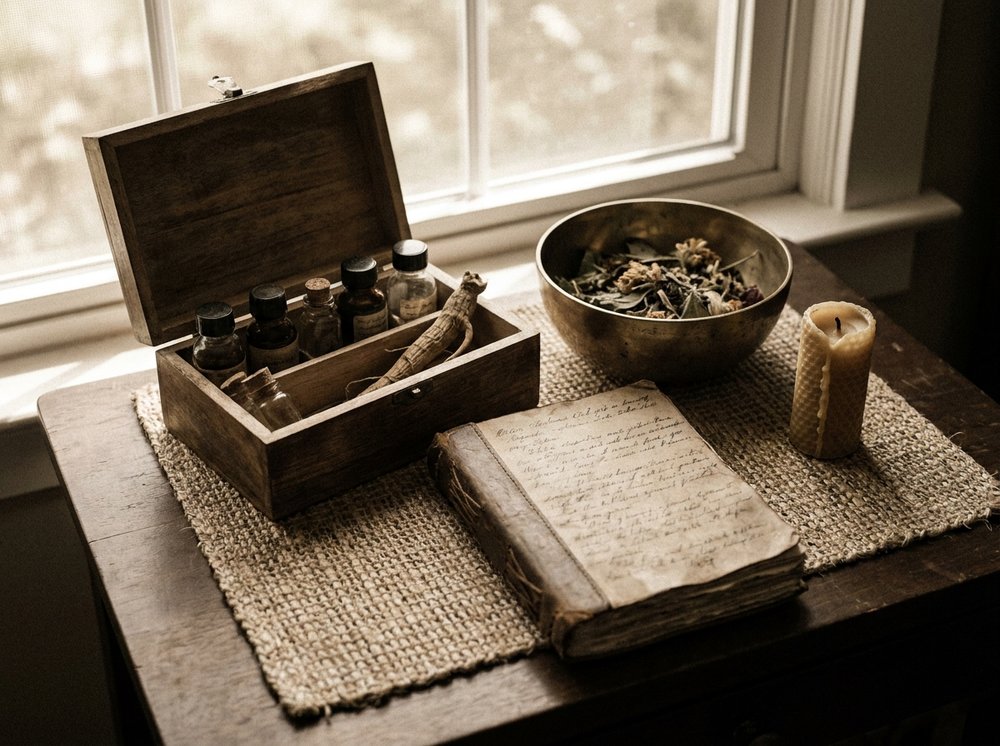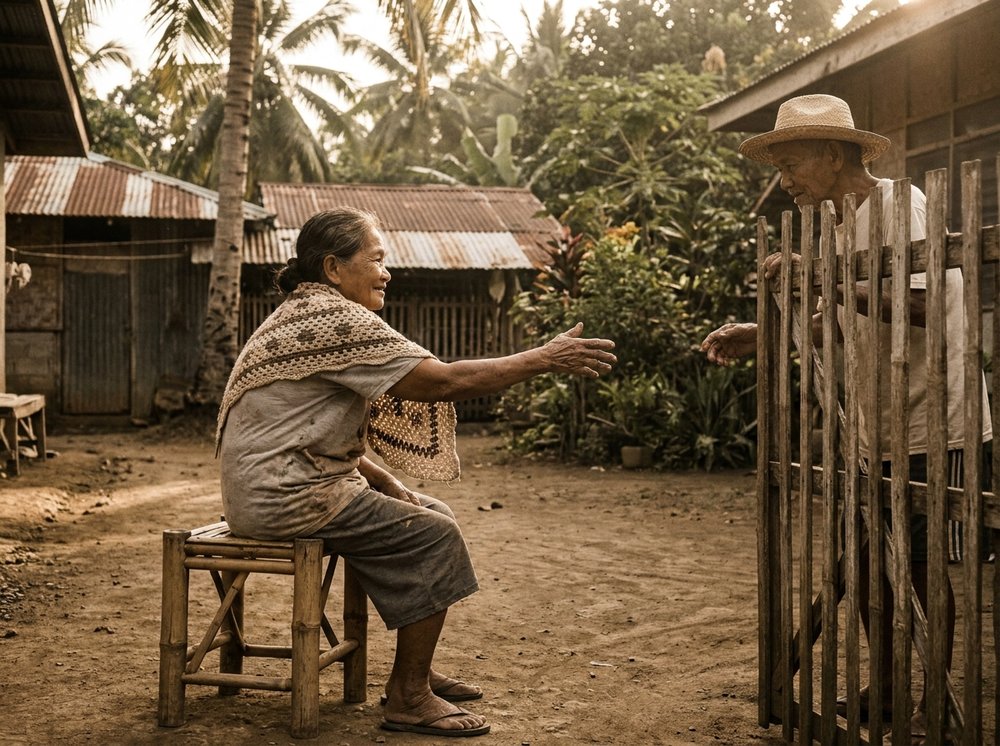
In Baclayon, where I grew up, every barangay had a manghihilot. Ours was my grandmother, Lola Salud. She was not paid a salary. She was paid in a basket of kamias from one household, a kilo of rice from another, a few pesos wrapped in banana leaf from a third. A pig slaughtered for a fiesta always meant she got one of the better cuts. If you asked her what her job was, she would say, "I am a grandmother." Only in English-speaking company did she allow the word healer.
This piece is about what she did. I want to describe the texture of a day in her life — because that texture, more than any written text, is what we still carry into our hilot work here in Quezon City.
The morning: the yard, the stove, the first visitor
She was up before the sun. She swept the yard, watered the sambong and the banaba, boiled rice and fried whatever was left from the night before. By six a.m., the first visitor had usually arrived. Often it was a woman, five or six months pregnant, who wanted her baby "turned" — meaning gently encouraged into the right position for birth. Sometimes it was a man with a crick in his neck from sleeping on his boat.
Lola Salud did not keep an appointment book. People came when they could and waited if they had to. In between, she talked. She asked about the guest's mother-in-law. She asked how the rice harvest was going. She asked if the children were eating. This talking was not small talk. It was, in its own way, her intake form — a careful mapping of where the body's difficulty sat in a larger field of family and work.
The session itself
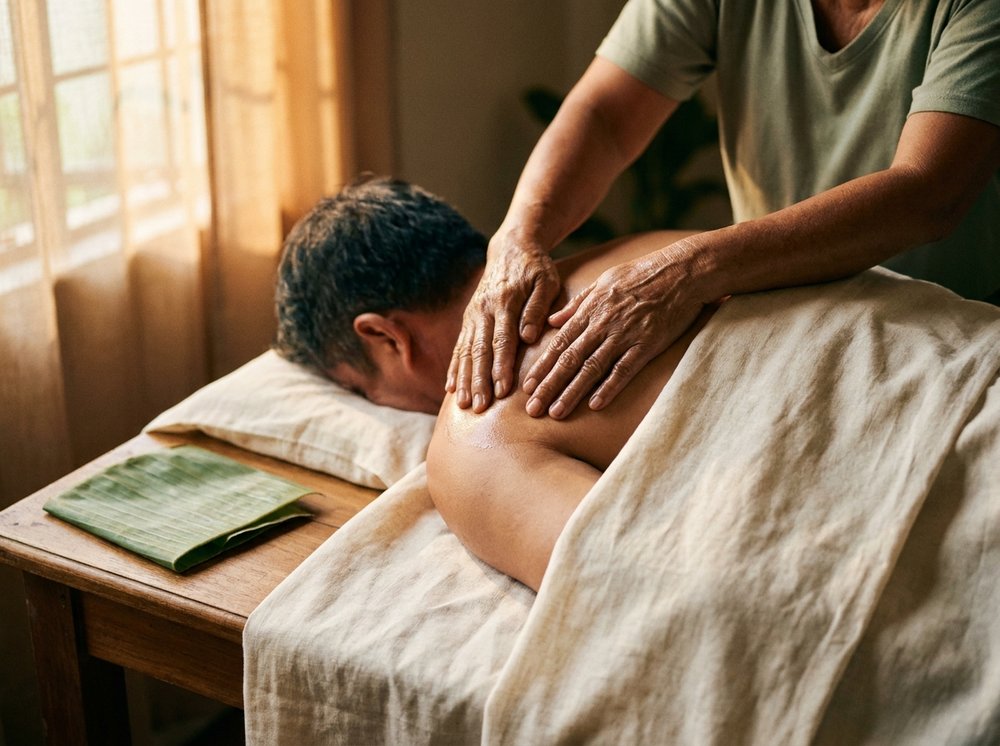
Her sessions were usually short — twenty to thirty minutes. She warmed coconut oil in a shallow saucer. She used one hand to hold the guest steady and the other to read, first, the radial pulse. The pulse told her where the hangin (trapped wind, stagnant energy) was. Then she worked — slowly, specifically, without unnecessary movements. She did not do a full-body massage. She did what was needed and stopped.
I once asked her why she did not work longer. She said: "If I keep pressing after the body has told me it is enough, the body closes. My grandmother said that. Her grandmother said that. I am only repeating."
"The manghihilot's strength is not in her hands. It is in her stopping."
— Lola Salud Salazar, Baclayon, Bohol, c. 1989
The middle of the day: trust, and the kinds of problems that came
After lunch she might walk to a neighbour's house — because someone too ill to come to her had sent a child to fetch her. She would take her little cloth bag of oils and plasters and go. By the time she arrived, the whole barangay usually knew someone was sick. People looked out of their windows. They asked, when she walked back, whether the patient was better. The healer's work was public in a way that modern clinical practice is not.
The problems that came to her were, I realise looking back, a mix of bodywork and counselling. Joint pain, yes. Post-partum recovery, yes. Bonesetting for children who had fallen from trees. But also the husband who could not sleep because of hangin sa loob, the interior wind, which might be worry or grief or a quarrel that had not been spoken out loud. Her job was to touch the body and, in touching it, give the person a chance to say what was wrong. Sometimes that alone was the treatment.
The role of trust
The manghihilot was trusted in a way that is very hard to manufacture in a commercial setting. She was not going to lose her position if a session went badly. She was not going to be fired. She had no supervisor. Her authority came from the fact that people had watched her, over years, work on their bodies and the bodies of their mothers and their children. If you had grown up on the same dirt road as her, you knew her competence the way you knew the taste of her pandesal — by long experience.
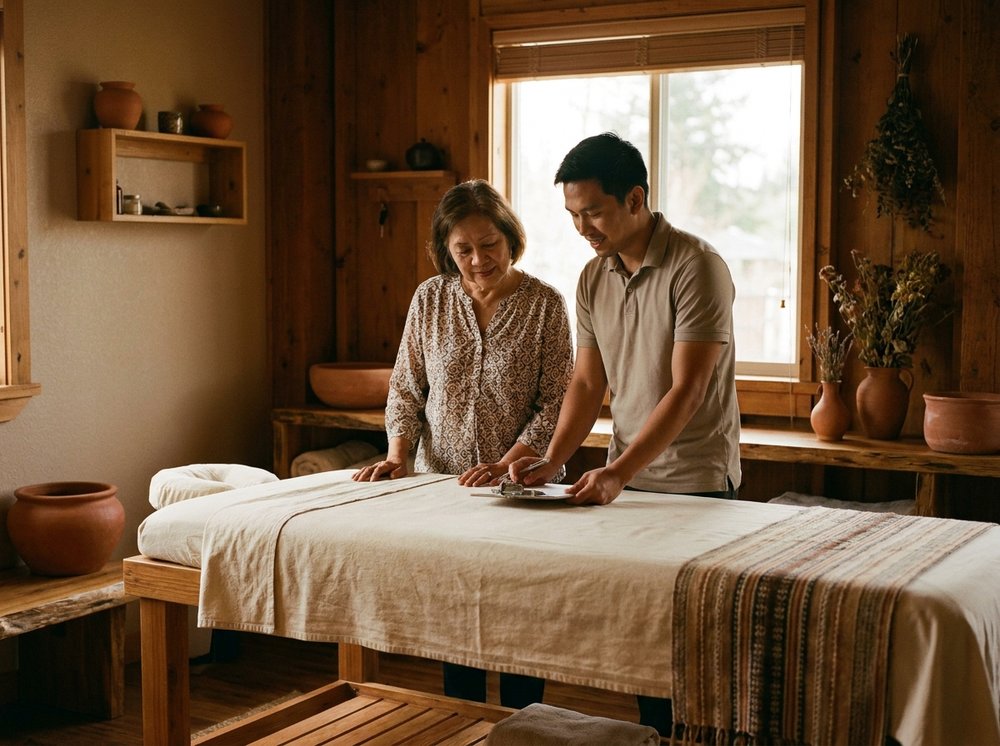
This trust is what we try, carefully and imperfectly, to rebuild in an urban sanctuary. We cannot replicate a barangay. What we can do is: stay small, keep the same practitioners over years, take our time with new guests, and let trust accumulate session by session rather than trying to promise it up front.
Why PITAHC certification matters now
In a small Bohol town in 1985, nobody asked Lola Salud for a certificate. The barangay knew who she was. In Quezon City in 2026, that knowing cannot exist the same way. A guest arriving from Tomas Morato has no way to tell, at first glance, whether the hands that will work on her belong to a trained healer or to someone who read a book.
This is where the Philippine Institute of Traditional and Alternative Health Care (PITAHC), created by Republic Act 8423 in 1997, has done quiet and important work. Our manghihilots are PITAHC-certified. That means they have completed formal training, passed competency examinations, and agreed to a code of practice. It does not replace the deep knowing of a barangay — nothing can — but it gives the urban guest a reasonable first layer of confidence. We have written more about the four-century history of hilot and the 1997 Act if you want the fuller story.
What the barangay tradition still teaches us
Three things, mostly.
First, take the time to ask. We do a twenty-minute conversation with every new guest. Not because we need it for liability purposes (we do), but because the manghihilot always began with a conversation.
Second, do only what is needed. Our sessions are 45, 60, 75, or 90 minutes, but if a guest's body is ready to rest after 55 minutes of a 60-minute session, we stop and let her rest. We do not fill the time with pressing. Lola Salud's rule.
Third, remember that the body belongs to a life. A frozen shoulder is rarely only a frozen shoulder. It is connected to the guest's work, her sleep, her household, her grief. We are not counsellors, and we say so clearly, but we listen. Listening is part of hilot.
Lola Salud died in 2004. She had worked until the last month of her life, at 81. Her hands, by then, were very thin. But the people who had been coming to her for forty years still came. That is the manghihilot's quiet legacy: not fame, not wealth, but a barangay of bodies that remember her. We hope, in a small urban way, to do the same.
If you would like to read how we weave the barangay tradition with modern clinical physiotherapy, we wrote on hilot and modern mobility care together. And if you are curious about the day-to-day experience of a session, our guide to what to expect from your first visit may help.